All Saints’ church, Longstanton burnt down in the summer of 1349 which would have been in the midst of an outbreak of the plague, which is on record as having reached Crowland Abbey lands in Oakington, Dry Drayton and Cottenham in the autumn of 1348. It is unlikely that the timing of this fire and the timing of the plague outbreak reaching Longstanton, are coincidence. With the plague known to ebb and flow in accordance with the seasons, the plague would have been heading towards it’s peak by the time of the fire. Whilst making the possible link between both these events was interesting enough, I have always wondered where plague victims of our villages were buried? Did Longstanton have a plague pit and if so why has extensive archaeology not identified one within the parish?
This article, based on recent research in Cambridge really does help give us an answer to the question, which was perhaps the most obvious answer after all. Whilst cities and large towns would have struggled to deal with their dead (hence the need for mass graves in some places) rural villages probably attempted to deal with their dead in the usual way, following traditional burial rites and burial in the village church yard. Maybe fatigue, fear or burning of straw (which was often on church floors) led to the catastrophic fire which destroyed All Saint’s Longstanton. Whilst traces of the former church can be seen in places, without the fire (and perhaps the plague outbreak) we would not have the glorious 14th Century Grade 1 listed church that we see today.
How did local clergymen fare during plague outbreaks? Often exposed early on in an outbreak to the dangers of the disease (after offering burial rites to the first plague victim), it is possible to see whether Rectors managed to survive the outbreak by looking at the list of Rectors and Vicars in our local churches. You can certainly see the list in All Saints’ church – so do take a look next time you are passing.
Do take a look at the link contained in the post below as it allows you to download a pdf of the research.
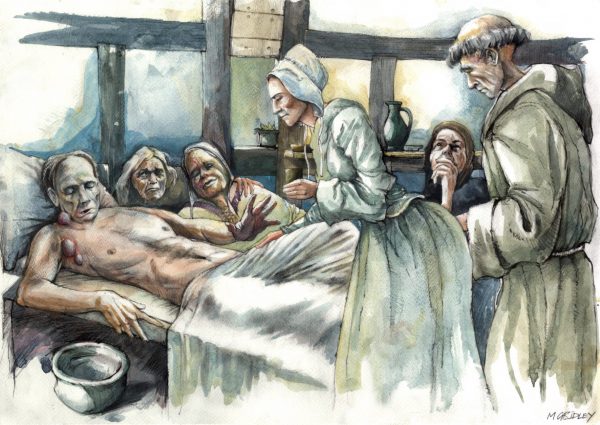
New recent published sheds light on plague burials in Cambridge Lead author Craig Cessford of the University of Cambridge said, “These individual burials show that even during plague outbreaks individual people were being buried with considerable care and attention. This is shown particularly at the friary where at least three such individuals were buried within the chapter house. The Cambridge Archaeological Unit conducted excavations on this site on behalf of the University in 2016-2017.
The individual at the parish of All Saints by the Castle in Cambridge was also carefully buried; this contrasts with the apocalyptic language used to describe the abandonment of this church in 1365 when it was reported that the church was partly ruinous and ‘the bones of dead bodies are exposed to beasts’.”
Full story  https://www.arch.cam.ac.uk/news/plague-medieval-cambridge
Reconstruction drawing of plague victim from All Saints, Cambridge. Image credit: Mark Gridley
Comments are closed.