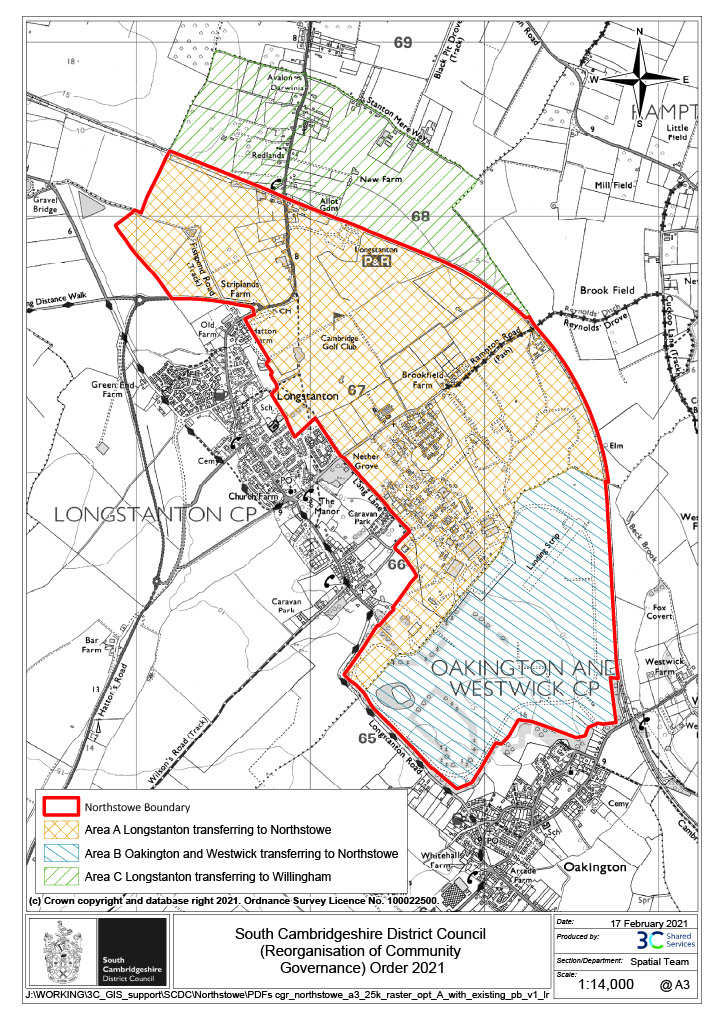
Oakington and Westwick appear to be similar to Longstanton in that the village has relied upon agriculture and the local landscape for most of its history. Inhabited by the Anglo-Saxons and Romans, Oakington must have provided a well resourced and good place in which to live. Close to the fens the villagers would have had access to food and transport via the waterways. In Domesday Book, Longstanton is recorded as having 3200 eels which shows that the close proximity of the fens did benefit the village. I do not recollect Domesday Book recording eels for Oakington & Westwick and if it did not at this sort of level. I will however, check up on this and add in the details in due course.
Dominated by a manorial system, villagers would have relied primarily on the lords of the manor, and as the 19th Century progressed, increasingly on a small number of principal families like the Linton’s for their housing and employment. The rural setting of the village and its manorial system influenced the development of the village and traces of this past can still be seen today. Westwick Farm and Westwick Hall with the old paddocks and sheep grazing help provide us with a glimpse of a by-gone era. It is probably only since the 1930’s that employment outside the village and agriculture enabled local villager’s to make the most of new opportunities.
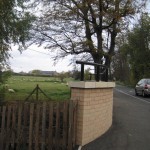
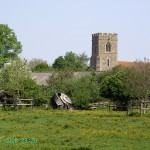 Images by Hilary Stroude – Westwick 2007; paddocks 2008.
Poverty and hardship in agrarian communities would have been common and it is of no surprise that after in the after-math 19th Century Enclosure Act combined with an agricultural depression and an intensifying Industrial Revolution many families were literally forced to leave Oakington to seek a better life in Australia or across the Atlantic. Rob Gee’s family is one such example. The wife of his Great Great Grandfather George Gee died on board the ship on route to a colony in South Australia. George Gee came from Longstanton but he moved to Oakington after he married in 1839. He and his wife and George’s 4 sisters all decided to emigrate in the same year 1852. He and 3 of his sister went on the same ship the ” Epaminondas” which left Liverpool on 14th April, 1852.
The following extract from The Cambridge Chronicle (Central Library Cambridge) recalls the event.
10th April 1852 Oakington
On Wednesday last, eleven families left this village to go by the “Epaminondas” from the Birkenhead Docks, Liverpool, to Port Adelaide South Australia. About ninety persons left this village last year and many others say they will go after them – before they will stay here and be starved to death. When they started off they gave a shout and said “Goodbye, old Hoggington”. If they should live to get over safe, and settle in some place and form a village, they would not call it by that name, for they were tired of hearing it.
This information has been kindly given to LDHS by Rob Gee who came to visit Longstanton in the footsteps of his ancestors. What a huge amount of information about Hoggington (old name for Oakington) we can glean from this one extract. For such large numbers of people to be driven from their homes the situation in this village and others must have been desperate.
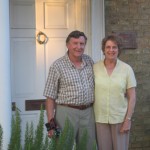 Photograph of Rob Gee and his wife visiting LDHS at The Manor, Longstanton 2007.
In Longstanton the Stukins family, a long standing local family, left to seek their fortune in London. What they found, according to a direct descendant Joe Stewkins, was utter poverty. More information on this family will follow in due course. The effects of the collapse of the agricultural system that had been the foundation of our local villages must have been immense. After the Enclosure Act access to common grazing land for many villagers disappeared over night and this must have left many families in a desperate situation. This period in the histories of Longstanton and Oakington & Westwick I think is fascinating and I am sure is worthy of detailed research.
Today of course many villagers of Oakington & Westwick work outside the village, particularly in Cambridge. In recent years local government policies and the Internet have enabled more villagers to work either at home or nearby on the Business park on Dry Drayton Road. It is perhaps not unfair to say that the changes seen in Oakington & Westwick in the last 50 years are probably more than occurred in the village since the 15th Century.
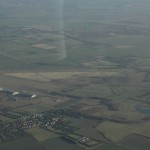
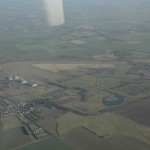
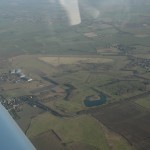
Below are some photographs taken by Richard Flagg. They show the airfield but also the landscape between Rampton – Longstanton – Oakington and Cottenham. We are most grateful to Richard for allowing us to use some of his images.