Recollections of Teaching in Longstanton 1951– 55
By Thelma Jopling (then Thelma Jones)
I started teaching at Longstanton in September 1951. I was straight from Training College and aged twenty. There should have been two of us but the other teacher had not been appointed. However a lady arrived who was supposed to be temporary, she was Mrs. Cooke, the wife of the Vicar of Impington. She was considerably older than me, but her only teaching experience had been at St Paul’s Girls’ School in London. At that time Longstanton had no Head Teacher, but a peripatetic Head for Fen Drayton, Swavesey and Longstanton travelled between them, turning up with us now and then!
Even by 1950’s standards the school building on the corner was old and inadequate. It consisted of two rooms, and a cloakroom, with two bucket toilets outside. The classrooms were heated by “tortoise” coke stoves. These had to be stoked frequently. They were certainly efficient at heating the rooms, as long as we remembered to attend to them before they got too low – not always our first thought when busy with children. There was no electricity and no telephone. There was one cold tap in the cloakroom, and a gas boiler, which heated the water for washing-up after lunch.
Lunch arrived from Willingham School in insulated containers and was served by Mrs Janet Childs. She came in at lunch-time, and also cleaned the school in the evening. To get a cup of tea we would put a kettle on the stove and in the summer we took in a methylated spirit picnic heater. In the winter the children’s milk was often frozen so we stood the bottles round the stoves to thaw out! Wet clothes were hung on the fireguards to dry. The only place for the children to play, or to have P.E., was the concrete area inside the railings by the road. What would Health and Safety say today???
We had just the Infant children in the old school; the juniors were in a hut on the “camp”, as the RAF base was called. At that time more than half the children were from RAF parents and many of them were much travelled and had been in many different schools. I had one little girl who by the time she was eight had been in thirteen different schools! For the first year I had the older Infants and Mrs Cooke had the reception children. We were left to our own devices most of the time. A regular visitor was the Vicar, Mr. Hale, and we depended on him for any help we needed. The vicarage was just over the road so he was easy to send for. He had a phone, so if there was an accident he could get either the Head, or help from the surgery on the camp. A little boy pushing a crayon up his nose was about the worst thing that happened.
In my second year a Headteacher was appointed. He was Mr Reg Lord and he was based on the camp. Mrs Cooke departed and Miss Marjorie Bennet arrived. I had been in the same form as Marjorie at school, and as we were both involved in the Guide Movement we had a lot in common. We got on well and stayed friends for life. Sadly Marjorie died five years ago.
None of the facilities improved at all, but we did feel more a part of the whole school as Mr. Lord visited often, and there was more contact with the rest of the children. We put on a Christmas concert in the camp Cinema. I can’t remember what we did but the concert became an annual event. Another event I remember was watching the Hunt meet on the green outside the school. It caused great excitement, as the children knew quite a few of the people involved.
We were very restricted in what work we could do, mainly because of lack of equipment. Without electricity we had no light, which meant on dull days or in the winter afternoons, we couldn’t read or do anything which demanded a good light. Often we had to tell stories or sing songs. Neither Marjorie nor I played the piano, but I could read the top line of music so sometimes picked out a tune using just the melody. Every time I hear the “Jesus Bids Us Shine” I think of the Cary Bonner book of children’s hymns, and those dark afternoons in that little school.
In the summer it was much easier and we would take the children out to find flowers or creepy-crawlies with no worry about health and safety. The meadow next to the school was a good place to go to, and the way in was to lift the children over the wall. That is another thing we could not do today. We let the children play there on nice dry days, as there was very little space for sixty or more children in the playground. We didn’t know at that time that sewage seeped into that field!
The next year I was moved to the camp and had the youngest junior class. This was another experience. Here the other member of staff, Sheila Lodder, had the top juniors and Mr Lord reigned as a non-teaching Head!! We had classes of 48, in cold rooms in a hut. The hut had walls one brick thick, no insulation, concrete floors with coconut matting, and although each of the two rooms had coke stoves they made no noticeable difference to the temperature! In the winter it was often below freezing, and we would sit in our coats and gloves and huddle round the stoves – if we had managed to keep them alight.
Every now and then there would be Lightning aircraft taking off just outside our rooms. We got used to noise, merely sitting with our hands over our ears until they had gone. We did have a big area of grass within the school fence, but this was always very wet in the winter so the children could not play outside.
On the camp our sanitation was equally primitive. There were six bucket toilets, three for girls and three for boys, with none at all for staff! We relied on a firm called Tovey Transport for emptying the buckets, and we often had to phone for them to come quickly as the buckets were on the point of overflowing. The smell was appalling! Again there was no water available and no facilities for cooking.
By this time it had been decided that Longstanton needed a new school, and so one was built on land which had been part of the Hatton estate. We were very excited about it, and often went to look at the building in progress. In the following year most of us moved into the new school. But the number of children had increased by then, and the reception infants had to stay in the old school until an extra classroom could be built. At about this point Sheila Lodder left to get married and Mrs. Margot Tolliday came; Mr Lord now taught again, taking the top class, and Margot Tolliday stayed in the old school with the youngest ones.
I loved my classroom in the new Hatton Park School. It had cupboards, proper desks, a lovely floor and big windows which actually opened. The hall was beautiful with a shiny parquet floor (so shiny on the Opening day that Mr. Lord slipped over on to his back in front of the Bishop and Lord Tedder. I’m afraid we staff thought it funny). There was a kitchen in which delicious meals were cooked by Mrs. Abbs and her helpers. At lunch time the children sat at tables for six, put together in hexagon shape, with an older child to serve the younger ones – ‘Family Service’ it was called, all very modern and civilized. The staff sat together at their own table. All this was so good compared with what we had had before.
At the end of the first year the tiles in the corridor had to be renewed as they kept coming unstuck, but that was a very small matter and we all loved our new school.
One of the biggest problems faced during the building was what to do about the pond. It had been a clay pit and was now disused. At first it was going to be filled in, but we all thought it should be kept as it was an interesting addition to the field. So eventually one side was levelled out by putting in a shingle beach, and the deeper part was fenced off and trees and reeds planted around it. It is lovely to see that the pond has been retained.
These are a few of the things I remember about the new school:-
Ming Ming, the Siamese cat, who had been moved to Birmingham but walked all the way back to take up residence in the school. She spent many hours sitting on my register in the sun.
Marjorie and I in the tiny staffroom/library, teaching ourselves to play the recorder. We managed to keep about one step ahead of the children.
A total eclipse of the sun, when the birds put themselves to bed with the twilight and woke again as the sun returned. We all sat outside to experience the eclipse.
The official opening, by Air Marshal Lord Tedder. Marjorie and I bought new suits for the occasion.
Taking my life in my hands by cycling across the airfield and over the main runway to get home to Girton. The gate at the Longstanton end was supposed to be shut, but often wasn’t.
Coming up with a design for what today would be called the school logo and what we called the school badge. We chose the Golden Hind because of its Hatton connection. I embroidered the first one as a prototype.
Some years ago I was taken over the old school, now converted to a private dwelling, and although I thought it was lovely I wondered if white mould still grew on the inside walls. After Longstanton I taught in two schools in Cambridge and they were happy schools most of the time, but I don’t think that, despite its undoubted problems, they were any happier than our little old school on the corner.
I retired from teaching in 1990, but I look back very fondly to my Longstanton days. I still remember many of the children, and have never parted with the tin that a little girl called Gloria Flatters gave me to keep my dinner money in. I often wonder if any of the RAF children went on to have brilliant careers in the service.
It was lovely to be in Longstanton again last year for the opening of the fine new school. But I can’t help regretting that our fine new school has disappeared for ever.
Thelma Jopling, June 2010
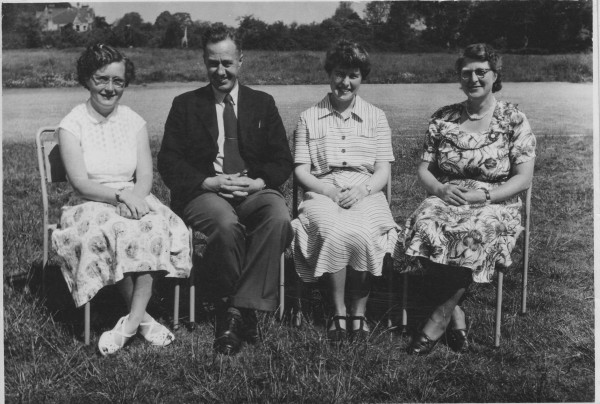
The photograph below from left to right: Thelma Jopling, Mr Lord, Marjorie Bennet and Margot Tolloday after the move to the new school.